Ħaġar Qim and Mnajdra: Tickets, Hours and the Walk Between
Ħaġar Qim and Mnajdra: €10 adult ticket, winter hours, the 500 m path between the temples, the equinox light and access on the Qrendi coast.
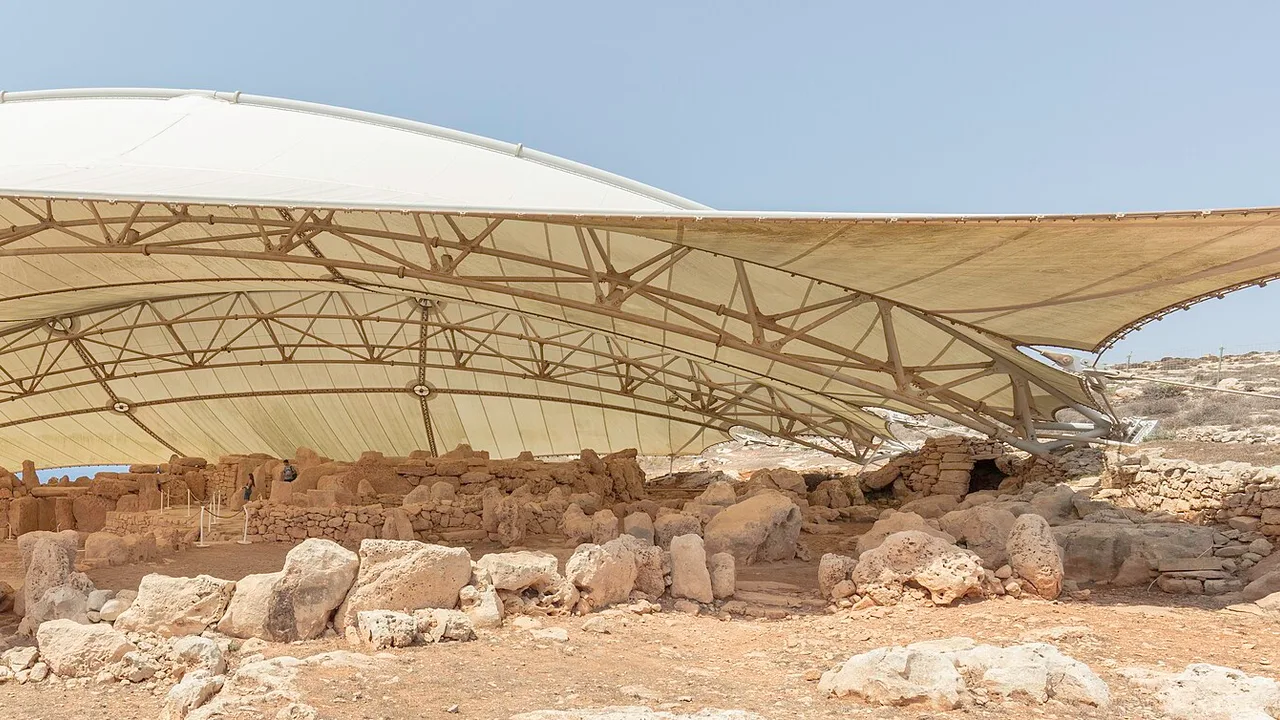
Ħaġar Qim stands on a ridge on the Qrendi coast, and Mnajdra lies about 500 metres below it down a paved path with a steep incline, so it’s the climb back that you’ll want to plan. Mnajdra is three separate buildings around one forecourt, and at the equinoxes and solstices the rising sun lights particular parts of one of its passages.
By road it’s about 15 km and 20 minutes from Valletta, and the Blue Grotto at Wied iż-Żurrieq is 2 km further on, which is why the four-day route does the temples first and the sea caves after.
Tickets and hours
If you’re buying admission yourself, Heritage Malta listed adults (18+) at €10; youths aged 12-17, seniors aged 60 and over, students and concessions at €7.50; children aged 6-11 at €5.50; and infants free, checked on 17 November 2026.
| Who | Ticket (17 November 2026) |
|---|---|
| Adults, 18 and over | €10 |
| Youths 12-17, seniors 60+, students, concessions | €7.50 |
| Children 6-11 | €5.50 |
| Infants 1-5 | Free |
Through the 2026-27 winter the park opens 09:00-17:00 daily until 3 January 2027, then 09:00-17:00 except on Tuesdays from 4 January to 28 February 2027, with last admission 30 minutes before closing; like the operator’s other sites, it shuts on 24, 25 and 31 December, 1 January and Good Friday. The operator suggests allowing anything from 90 minutes to three hours, and that range is why you’ll want to start in the morning: the walk down, the walk back up and two sites fill the long end of it.
The visitors’ centre has a shop with snacks and drinks, and the nearest restaurants named by the operator are at Wied iż-Żurrieq and Għar Lapsi, so lunch is a short drive away.
Getting there
Heritage Malta puts the closest bus stop 3 minutes on foot from the entrance and links Malta Public Transport’s trip planner without naming a route, so enter the park as your destination and the planner gives you the stop from wherever you’re staying. If you’re driving, our car-hire guide covers the wider questions; the car saves you the bus connection, but not the slope inside the park. Add it up before you plan the afternoon: 20 minutes’ drive from Valletta and 90 minutes on site make a morning, while the full three hours plus the short drive to the Blue Grotto run past lunch.
The path between the two sites
Heritage Malta’s access statement, which we read on 16 November 2026, puts about 500 metres of paved path with a steep incline between the two sites. The walking around each temple and the visitors’ centre comes on top, and every metre down to Mnajdra is a metre back up. The path is in the open, so it’s worth looking at the forecast.
Ħaġar Qim: the doorway and the central passage
The National Museum of Archaeology’s account of Ħaġar Qim describes a central passage connecting chambers, entered through a monumental façade. Heritage Malta adds that the main structure is unusual, with features and doorways along its external wall, and that the site sits on the crest of a ridge: to the west it looks over the open sea, and to the east over the edge of a large fertile plain.
Look at the doorways first. Heritage Malta says those inside the structures are either trilithon, two upright stone blocks with a lintel and threshold, or an opening cut into a single megalith, known as a ‘porthole’ doorway. The floor of the central passage is paved with stone slabs, while the chambers branching off it have floors of beaten earth, and parts of the structure were originally covered by a corbelled roof of successive courses of megaliths, each smaller than the one below.
The original low-relief carvings are now represented by copies in the structure: one original is displayed at the National Museum of Archaeology in Valletta and the other at the visitor centre, so the centre is worth a stop before you walk out. At each opening, see what it frames, then carry that habit downhill to Mnajdra.
Mnajdra: three buildings, one forecourt
Mnajdra comprises three separate buildings approached from a common forecourt, according to the National Museum of Archaeology’s description, and Heritage Malta adds that they are built in both globigerina and coralline limestone. Heritage Malta gives the building order: the small three-apsed structure, then the South structure with its concave façade, then the Central structure, raised on an artificial platform between the two earlier ones. Beside the central passage with chambers on either side, there are tiny chambers built within the thickness of the walls.
Choose a feature you noticed at Ħaġar Qim, such as a trilithon doorway or a porthole opening, and look for its equivalent here. Then stand in the forecourt and look at the concave façade of the South structure: it’s the one the equinox sunrise lines up with.
Sunrise at Mnajdra
Heritage Malta says the doorway of the South structure is aligned with the sunrise at the spring and autumn equinoxes, around 20 March and 23 September. At the winter and summer solstices, around 21 December and 21 June, the beams of the rising sun pass along the sides of the main doorway, each time illuminating a different decorated slab in the chamber just inside it. Its news page on the alignments says it isn’t clear whether the orientations were intentional, and goes on to call it very probable.
If the light’s your reason to come, look for a sunrise visit announced by the operator for your travel period and read its booking arrangements. On a daytime visit you’ll still see the South doorway and the decorated slabs inside it, so you’ll know what the sunrise lights even without being there for it.
The shelters over the temples
The covers over the temple areas are part of a conservation response. UNESCO explains that excavation exposed the monuments to deterioration and describes lightweight, removable protective covers as an interim strategy to prolong their life while other approaches are studied. They don’t hide the stone, but they do change the look of the setting.
Lift, steps and uneven ground
The operator’s access statement, checked on 16 November 2026, gives lift access to the visitor centre, rough or uneven ground on parts of the approach, and different levels with uneven steps at Mnajdra. The park page, checked on 17 November 2026, puts it more plainly: the visitor centre and Ħaġar Qim are accessible, though assistance is still needed at Ħaġar Qim, while Mnajdra is not. The statement is an older document, so if slopes or steps matter to you, ask Heritage Malta about the current route before you book.
Travelling independently or with a guide
On your own you choose where to linger; a guided visit explains more, but it sets the pace. Our week across Malta and Gozo places the south coast on a day of its own.
If you want to compare, Ġgantija on Gozo pairs Coralline outer walls with softer Globigerina inside, and the Hypogeum in Paola was cut into the rock on three levels. The National Museum of Archaeology in Valletta displays tools, vessels and representations of people and animals from Malta’s prehistoric past, and one of the original carved slabs from Ħaġar Qim is there too.
Photos
Tickets and opening hours
- Ticket price
- Adults (18+) €10, youths 12-17, seniors 60+ and students €7.50, children 6-11 €5.50, infants free (Heritage Malta page, 17 Nov 2026)
- Opening hours
- 09:00-17:00 to 3 Jan 2027 (closed 24, 25, 31 Dec and 1 Jan); 09:00-17:00 except Tuesdays 4 Jan-28 Feb 2027; last admission 30 minutes before closing
Allow 90 minutes to three hours; the path between the sites is 500 m with a steep incline; Mnajdra is not accessible per the park page.
Details checked: 17 November 2026
Read also

What to see · 6 min read
Ġgantija Temples: Tickets, Hours and Reading the Stones
Verified · 17 November 2026Ġgantija in Xagħra: €10 combo ticket with Ta' Kola, opening hours, painted plaster, two kinds of limestone, access and how to get there.

What to see · 6 min read
Ħal Saflieni Hypogeum: Tickets and the Visit
Verified · 17 November 2026Ħal Saflieni Hypogeum tickets: €35 adult, €50 last-minute, the 15-minute rule, shoes, lockers, the January 2027 closure and getting to Paola.

What to see · 6 min read
St John's Co-Cathedral: Tickets, Hours and Caravaggio
Updated · 17 November 2026St John's Co-Cathedral in Valletta: €15 adult ticket, Monday to Saturday hours, dress code, where Caravaggio's Beheading hangs and how long to allow.

Things to do · 7 min read
Best Beaches in Malta and Gozo: Sand or Rocky Shores?
Verified · 17 November 2026Malta and Gozo beaches by sand, rock and how you get in: Golden Bay, Għajn Tuffieħa, Mellieħa, Ramla, Ħondoq, Sliema rocks and the Blue Lagoon.